Prefer to listen?
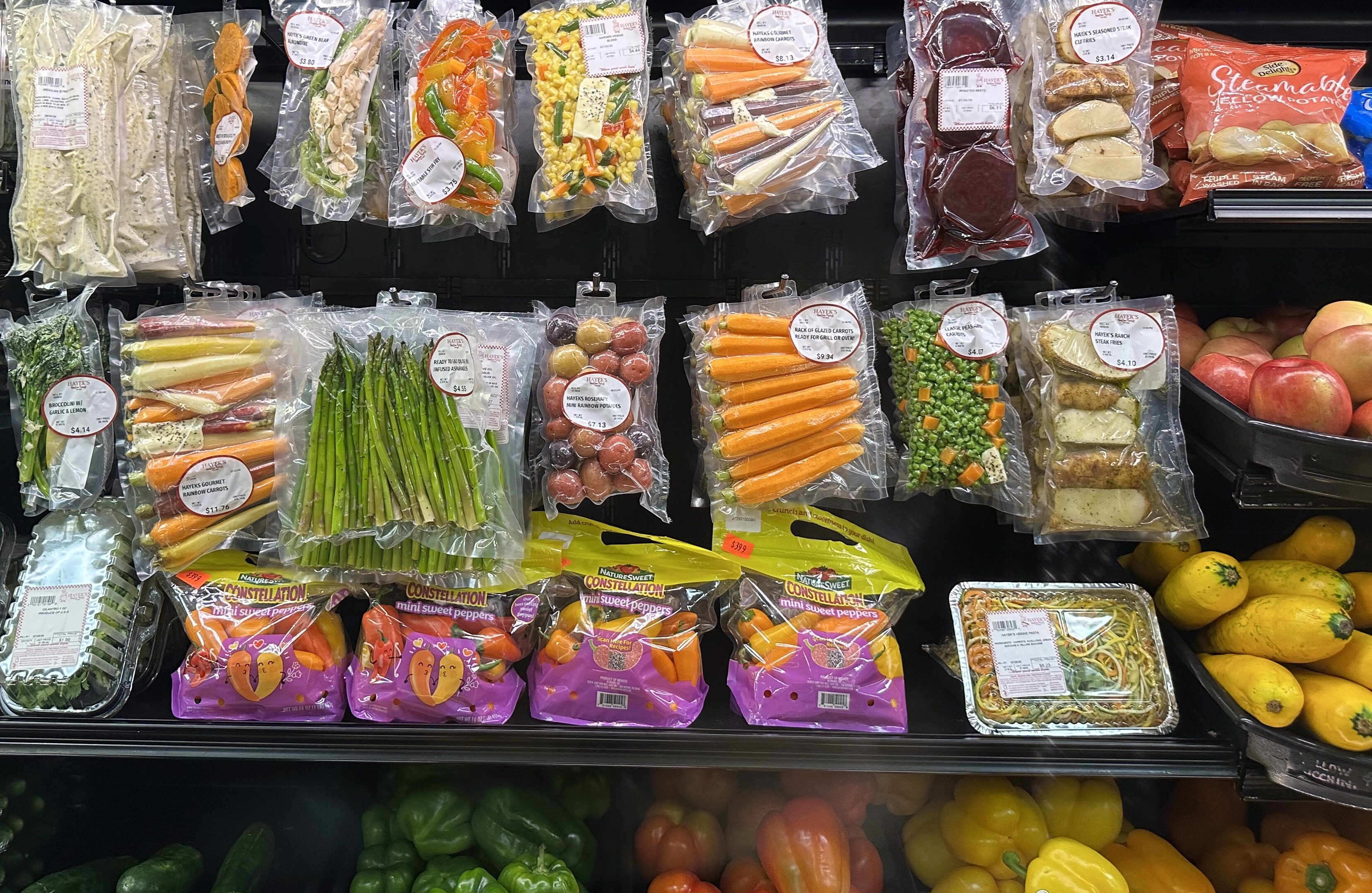
I took this photograph while browsing the aisles of a charming upscale market in northern New Jersey. Packages of asparagus, rainbow carrots, peppers, beets, broccoli, peas, and potatoes hung against a black wall like pieces in an art installation. The vegetables were arranged by color and shape, each transparent package reflecting the carefully positioned lights. The display was beautiful. Mesmerizing, even.
It was also a little unsettling.
Nearly everything had been washed, peeled, cut, portioned, and vacuum sealed. Carrots had been separated from their tops. Beets had been separated from their greens. Peppers had been sliced into uniform strips. The vegetables looked fresh but they also looked strangely suffocated, as though nature had been preserved under plastic just long enough to become a product. This was already more meal preparation than I had done that entire week.
Granted, these foods are not “ultra-processed” in the nutritional sense so often discussed these days. They do not contain long lists of industrial ingredients. Yet they seemed ultra-processed to me. Each vegetable had passed through multiple stages of preparation and presentation before reaching the customer. It had been selected, cleaned, cut, measured, sealed, labeled, priced, and visually framed. Almost nothing remained for the customer to do except open the package.
Now, there are legitimate reasons for selling produce this way. Prepared vegetables can help people with disabilities, limited mobility, demanding schedules, small households, or limited kitchen facilities. They may also reduce waste when someone needs only a small amount. Convenience is not inherently bad, and purchasing sliced carrots is certainly not a moral failure.
Plus, the display was doing what an effective market display is supposed to do: making food appealing and accessible. So my response here is less a judgment of the store than a question about the larger habits the display reflected, including my own.
The question that emerged for me is this: What happens when convenience becomes the default rather than an occasional form of assistance?
Many of us have fewer opportunities to develop confidence in preparing fresh food. A whole beet can seem mysterious compared with a sealed package of beet slices (Which is actually moot because I do not like beets). A head of broccoli requires a knife, a cutting board, and some understanding of what to do with the stalk. Unfortunate for some, a head of broccoli does not come with instructions.
Cooking skills once learned through families and communities are increasingly outsourced to food processors, meal-delivery companies, restaurants, and grocery stores. But recipes are more than instructions. They record the ingredients, tools, labor, knowledge, and even cultural assumptions that a person is expected to possess. I ask my college students to study historical cookbooks and consider how food knowledge is communicated, whose labor is recognized, and what disappears when meals become products rather than cultural practices.
These ideas extend beyond food media literacy. They raise questions about the entire environment through which our knowledge, skills, and choices are organized. And this is where where abundance can begin to feel strangely limiting. And where I think the concept of media permaculture becomes especially useful.
In my field of expertise, media literacy is usually described as a set of consumer skills: identifying bias, evaluating sources, recognizing misinformation, and protecting personal information. These abilities are essential, but they are incomplete. Genuine media literacy also requires production skills. In other words, people need experience writing, photographing, recording, editing, publishing, revising, and preserving their own work.
Someone who has edited a video understands how selection and sequencing can alter meaning. Someone who has cropped a photograph understands what disappears outside the frame. Someone who has written a headline knows how a few words can direct attention before the audience ever reaches the story.
Making media reveals the choices concealed within pre-packaged media. Just as preparing food reveals the labor concealed within a package.
The bottom line: When we stop making things, we become more dependent on the systems that make them for us. A package of precut vegetables determines the portion, shape, likely use, and shelf life. A social media platform makes similar decisions about information. It determines what appears, in what order, beside which advertisements, and for how long. Yes, both systems offer delicious convenience. But both systems can also reduce our direct involvement in the processes that sustain us.
Convenience has a way of putting our critical and creative muscles on an extended lunch break.

Long before the algorithmic feed, the TV dinner combined food and media consumption in one carefully packaged experience. The meal arrived already portioned and framed—much like the information served to us through contemporary platforms.
Media permaculture asks us to notice these relationships rather than examining each (media) object in isolation. A carrot is connected to soil, water, insects, weather, labor, transportation, refrigeration, plastic, and eventually waste. A social media post is connected to a creator, an audience, a platform owned by a billion-dollar corporation, an algorithm, a server, an advertiser, and the electricity required to keep the entire system running. That is quite a list of ingredients.
Just as my photograph is not merely a picture of produce, nothing available through the Internet is simply content.
My photograph also calls attention to the fact that natural food is stubbornly temporary. Broccoli yellows. Herbs wilt. Peppers soften. Freshness cannot be separated from time. Social media feeds create a different kind of perishability. A post appears, briefly attracts attention, and is quickly buried beneath the next wave of material. Yesterday’s thoughtful observation (or political bombshell) might remain accurate and valuable, but the algorithm has already moved on to today’s special.
We try to resist this ephemerality by preserving things, not unlike vacuum sealing vegetables. We take screenshots, create archives, and move posts into newsletters or personal websites (like this one).
Yet every form of preservation changes what it saves. Obviously, a sliced carrot sealed in plastic is not the same as a carrot held in the soil. But are we fully aware that an archived blog post no longer exists within its original moment, conversation, or community? The words may remain, but many of the conditions that gave them meaning do not. Links break, comments disappear, audiences disperse, and shared references become obscure. Removed from this living network, the post can appear permanent and self-contained, even though it never existed independently of its moment, audience, and community. The archive may preserve the content, but it cannot fully preserve the relationships that gave the content meaning. The vegetables remain, but the soil, season, labor, and relationships that produced them have disappeared from view. In much the same way, an archive may preserve a post while obscuring the social environment that originally gave it meaning.
To be clear, media permaculture does not require rejecting convenience, technology, or commerce. Nor does it demand complete self-sufficiency. I am not proposing that we churn our own butter before being permitted to post online. Rather, media permaculture asks us to preserve meaningful forms of participation within systems that are instead built primarily for consumption.
We can sometimes buy the whole vegetable, learn how to prepare it, save the scraps for stock, and compost what remains. We can make similar choices in our media lives. The alternative to passive scrolling is not simply posting something, especially when that “something” involves clip farming, rage baiting, or AI slopping to feed the algorithm. Those are the media equivalent of empty calories. They are easy to produce, easy to consume, and quickly forgotten. And often hazardous to public health.
Healthier participation might mean documenting a local history, recording a family member’s story, creating a genuinely useful tutorial (for automotive repair, please), contributing knowledge to a public archive, or writing an essay that develops an original idea. We can create (rather than merely repackage) and preserve worthwhile work somewhere beyond the ephemeral feed.
Notice in my photograph the loose bell peppers sitting beneath the vacuum-sealed packages. They are irregular, unmeasured, and full of possibilities. Yes, they require more from the consumer, but they also leave more choices in the consumer’s hands. This raises an important question that we should ask of both food and media: Does this system merely make consuming easier, or does it empower us to make something ourselves?
How we answer that question will help determine whether we endorse systems that cultivate capable participants who can create, adapt, and sustain their communities—or endorse systems that churn out dependent consumers that can only choose from what others have prepared and set before them. The latter is merely the illusion of choice, isn’t it?
Bon Appétit.