by Dr. Vanessa E. Greenwood, C+MRC Founder & Director The most amazing moment of virtual reality is when you leave it, not when you’re in…
Uncategorized
Doing Health Media Literacy

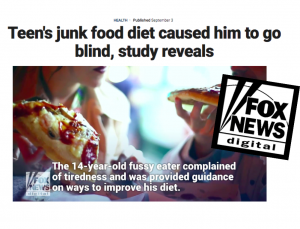
“Teen’s junk food diet caused boy to go blind.” “Even one diet soda a day may triple your risk for developing dementia.” “Dark chocolate may help prevent some forms of cancer.” These are just a few of the health news headlines (or click bait?) that we consume on a daily basis. But they rarely reflect the actual or nuanced research findings.
Indeed, health news reporters and editors must exercise precision and consideration of public interest when constructing news headlines. Yet, too frequently they (and we) fall into the fallacy of equating correlation with causation. A deeper dive into the first news story above (“Teen’s junk food diet caused boy to go blind”) uncovers the subtle yet distinct difference between “causing blindness” (the news headline) and “can lead to blindness” (language from the actual study). Additionally, these do not equate to “will lead to blindness.”
But health news reporters are not entirely at fault here. The burden is also on the shoulders of those of us who conduct research. In this case, the study is published in the Annals of Internal Medicine and titled: “Blindness Caused by a Junk Food Diet.” The researchers state as their objective “To alert clinicians of the visual complications of a diet restricted to junk food.” Which begs the question, “Is blindness the same as visual complication?” And were the pre-existing vitamin deficiencies in the 14-year-old patient entirely the result of consuming junk food or were there other health factors involved?
The nature of empirical research is complex in terms of presenting findings and then interpreting the significance of those findings. If the researchers themselves are nuanced (or unclear) in the findings and/or the implications of those research findings, then we can’t expect fidelity or additional truth when the research is translated into broadcast media messages for mass public consumption. Or can we? Read more
Health Media Literacy
“Teen’s junk food diet caused boy to go blind.” “Even one diet soda a day may triple your risk for developing dementia.” “Dark chocolate may help prevent some forms of cancer.” These are just a few of the health news headlines (or click bait?) that we consume on a daily basis. But they rarely reflect the actual or nuanced research findings.
Media Literacy from the Beginning
I am so excited to be a part of Right from the Start in the Digital Age launched by FHI 360 this week—during the inaugural…
Throw Back Media @NAMLE2015
What a great weekend in Philadelphia with media and information literacy educators from across the globe—convening for the 2015 NAMLE/MILID conference. The theme this year…
Join us at NAMLE in Philly this summer
Interested in joining me to learn more about media literacy & media use in the classroom? I am very excited about the eclectic program I’ve assembled of some of the best and brightest media literacy scholars, educators, practitioners, activists and artists around. Read more
10 Steps to Media and Technology Literacy
Rather than simply use technology to support instruction, I firmly believe that media technologies exist to transform teaching and learning in a reciprocally innovative relationship between teacher…

“This is Media” Screening and Panel Discussion
Thanks to a grant from the National Association for Media Literacy Education (NAMLE) and pivot tv, Montclair State University‘s College of Education and Human Services hosted…
Media Ecologies of Health Literacy
Government officials and medical professionals are greatly concerned about the health of children (ages 6-11) in the United States due to the increase in obesity-related…
Call For Proposals: NAMLE 2013
Deadline: January 21, 2013 (two-week extension) NAMLE is currently inviting proposals for participation in our 2013 NAMLE Conference to be held in Torrance, CA July 12-13th….