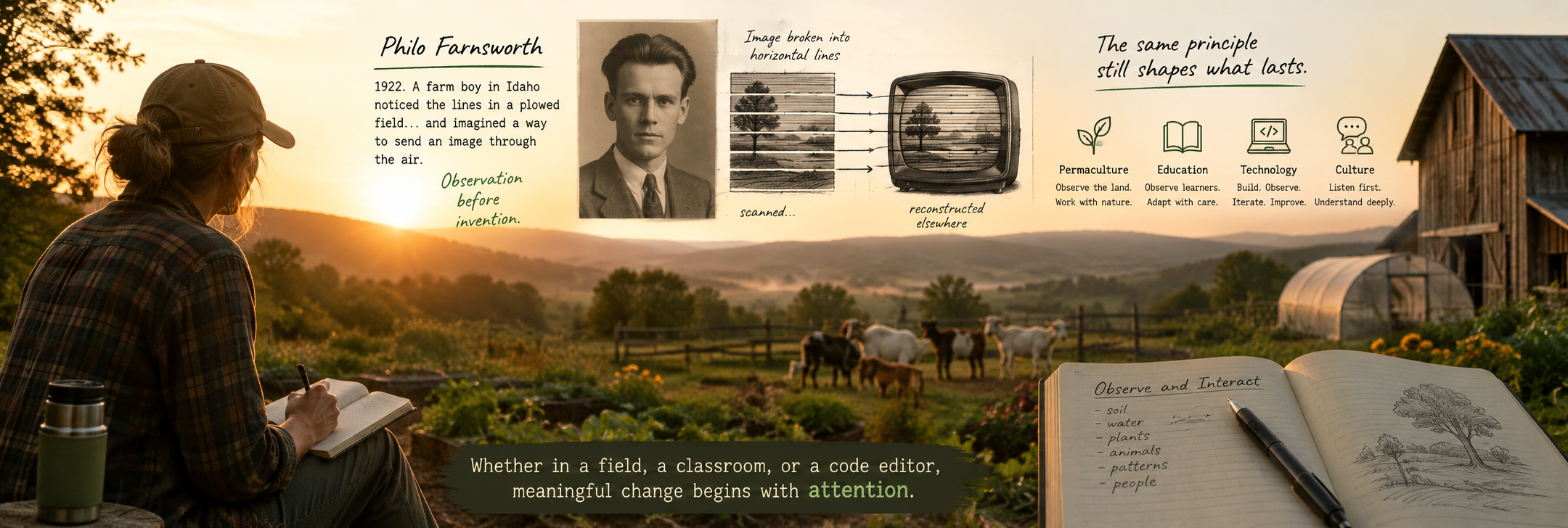
Image above is AI generated. Ideas below are human generated.
Prefer to listen?
In the summer of 1921, a fourteen-year-old farm boy named Philo Farnsworth was working behind a horse-drawn disc harrow on his family’s Idaho farm. Watching the evenly spaced furrows unfold across the field, he imagined an image being scanned one horizontal line at a time and reconstructed somewhere else. A year later, he sketched the idea on his high school chemistry teacher’s blackboard. That quiet observation would eventually become the conceptual foundation for the first fully electronic television. Long before there was a prototype, there was observation.
Philo’s story has always fascinated me because it reminds us that invention rarely begins with invention. It begins with attention. Someone notices something that everyone else has overlooked.
In computing, there is a simple principle: before you write data, you usually have to read it. Software doesn’t make wise decisions by acting first; it begins by gathering information. Read before write. It is a technical necessity, but perhaps it is also a human one.
Ironically, many of the technologies born from such careful observation now make sustained observation more difficult. Our phones reward immediacy. Social media celebrates speed. News cycles refresh by the minute. Artificial intelligence can generate answers before we’ve fully formed our questions. None of these technologies are inherently harmful; each has expanded our ability to communicate, create, and solve problems. But they also tempt us toward habits of constant reaction. Patience becomes inefficient. Reflection begins to feel like delay. We move quickly, yet often notice less.
I am not immune to this.
For years I approached problems the same way I approached much of modern technology: identify the issue, search for the answer, and implement a solution as quickly as possible. Efficiency seemed like wisdom. Then I began practicing regenerative homesteading. The land had other ideas.
When I first started raising livestock, I wanted to redesign every fence after a single escape. Every sick pig seemed to require an immediate diagnosis. Every muddy paddock demanded another weekend project. Gradually I discovered that the land was asking something different of me. It was asking me to slow down, watch, and read the landscape before trying to rewrite it.
I began noticing which parts of the pasture remained wet after heavy rain. Which animals preferred browsing over grazing. Which weeds appeared only after the pigs disturbed the soil. Which accidental plants emerged from seeds I never intentionally planted. Every observation became another piece of a much larger conversation.
Only after learning to observe could I begin to interact wisely. To my surprise, I realized I had been relearning something I thought I already understood.
Teaching works the same way. The best educators don’t simply deliver content. They first learn to read the learners in front of them. They notice confusion before it becomes discouragement. They revise assignments, adjust examples, and sometimes abandon a carefully prepared lesson because the students require something different than the instructor had anticipated. Good teaching begins long before the lesson plan changes.
The same principle extends beyond classrooms and farms into civic life. Healthy democracies require more than passionate convictions. They require citizens who are willing to observe before they react. Civil dissent has always depended upon the difficult work of understanding another person’s reasoning before attempting to persuade or critique it. That does not require agreement. In fact, genuine disagreement may be even more important. But disagreement without careful observation often means we stop reading one another and begin writing stories about one another instead. We begin responding to assumptions rather than arguments, labels rather than people, and headlines rather than ideas.
Perhaps this helps explain why our political conversations often feel less like dialogue than parallel monologues. We have become remarkably efficient at expressing opinions while becoming less practiced at understanding how someone else arrived at theirs. Observation is not surrender. It is the discipline that makes meaningful disagreement possible.
Oddly enough, software engineers eventually arrived at much the same conclusion. For decades, software projects often attempted to anticipate every requirement before writing significant amounts of code. More often than not, reality intervened. Users behaved differently than expected. New needs emerged. Assumptions proved incomplete. Software engineers eventually realized that they couldn’t anticipate every need from the outset. Rather than spending years perfecting a design before anyone touched it, they began releasing small, working versions, observing how people actually used them, and then improving them through repeated cycles of testing, feedback, and revision. Today we call this agile development, but its central insight is surprisingly old: observation should precede optimization.
Companies such as Spotify became well known for embracing this philosophy. They organized engineering around rapid experimentation, employed small autonomous teams (or squads) and generated continual user feedback. Their success was not built upon predicting the future perfectly. It depended upon paying close attention to what people actually did rather than what designers imagined they would do.
It strikes me that this principle belongs to far more than software. Permaculture expresses it in just three words: Observe and interact.
The order matters.
Whether we are cultivating a garden, teaching a class, writing software, participating in civic life, or composing a social media post, we are all tempted to write before we have adequately read. We redesign the land before understanding its contours. We revise a lesson before understanding our students. We critique another person’s ideas before understanding how they arrived there. We post before we pause.
Perhaps the oldest wisdom is also the newest:
- Read before write.
- Observe before optimize.
- Pay attention before taking action.
So, perhaps the greatest innovation we need today isn’t another technology.
It is the willingness to linger just a little longer before deciding what we think we see.