Prefer to listen?
August in New Jersey can make vegetation seem almost aggressive.
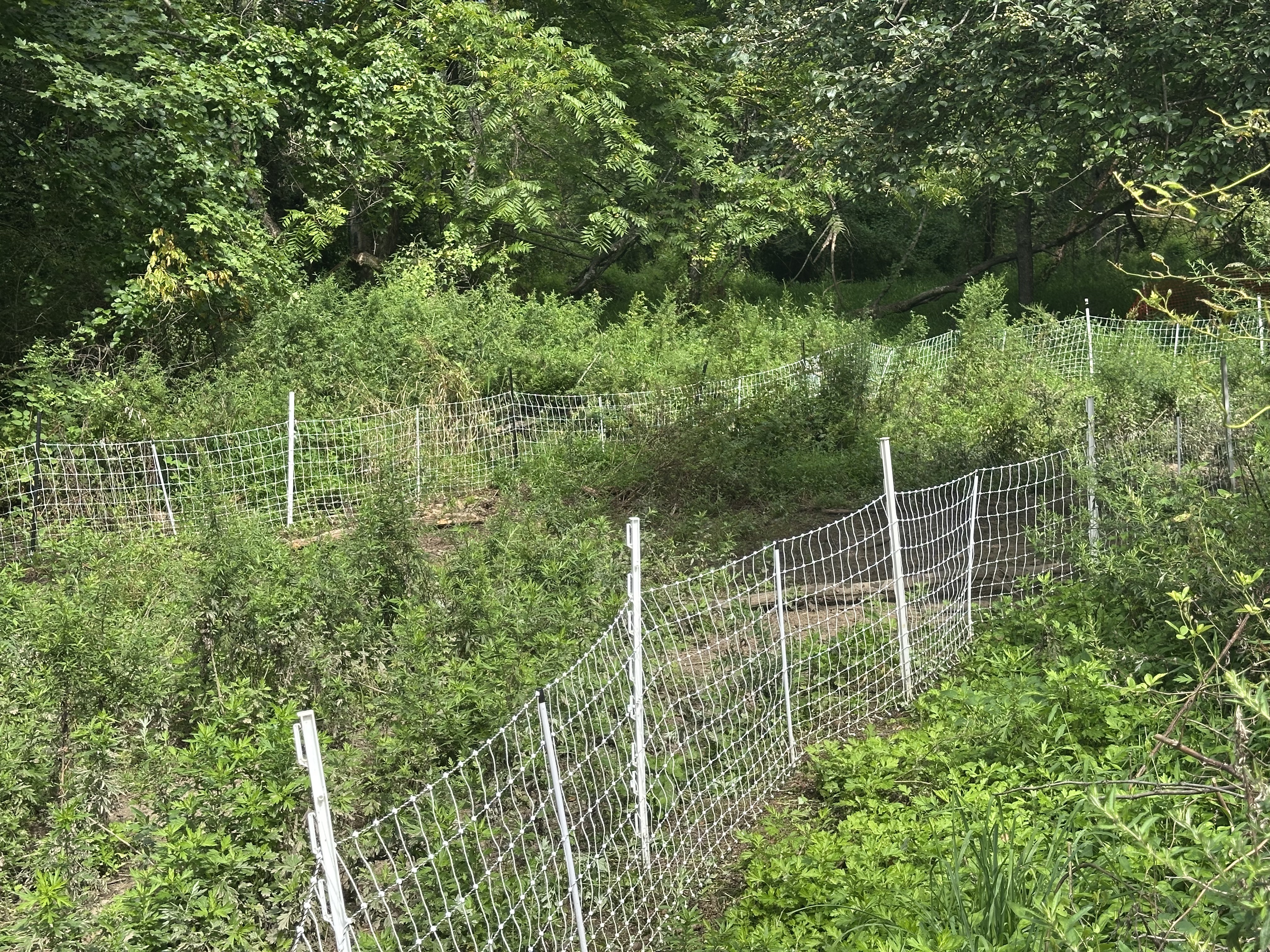
This morning I was working my way around the perimeter of my pig paddocks with a trimmer, clearing anything that might touch the electric netting. A milkweed leaf. A mugwort stem. A fallen twig. The trimmer buzzes, the humidity settles onto my skin, and seemingly every plant I cut is replaced by another one reaching for the fence.
Anything touching that netting can drain voltage from a system whose primary purpose is to convince several hundred pounds of determined pig that whatever lies on the other side is not worth investigating.
I despise this chore.
Partly because it is hot and repetitive. Partly because August humidity makes me question whether humans were really intended to inhabit New Jersey this time of year. But mostly because, while clearing the fence, I can see what lies beyond it:
Acres of woodland. Roots. Forage. Shade. New ground.
And inside the fence?
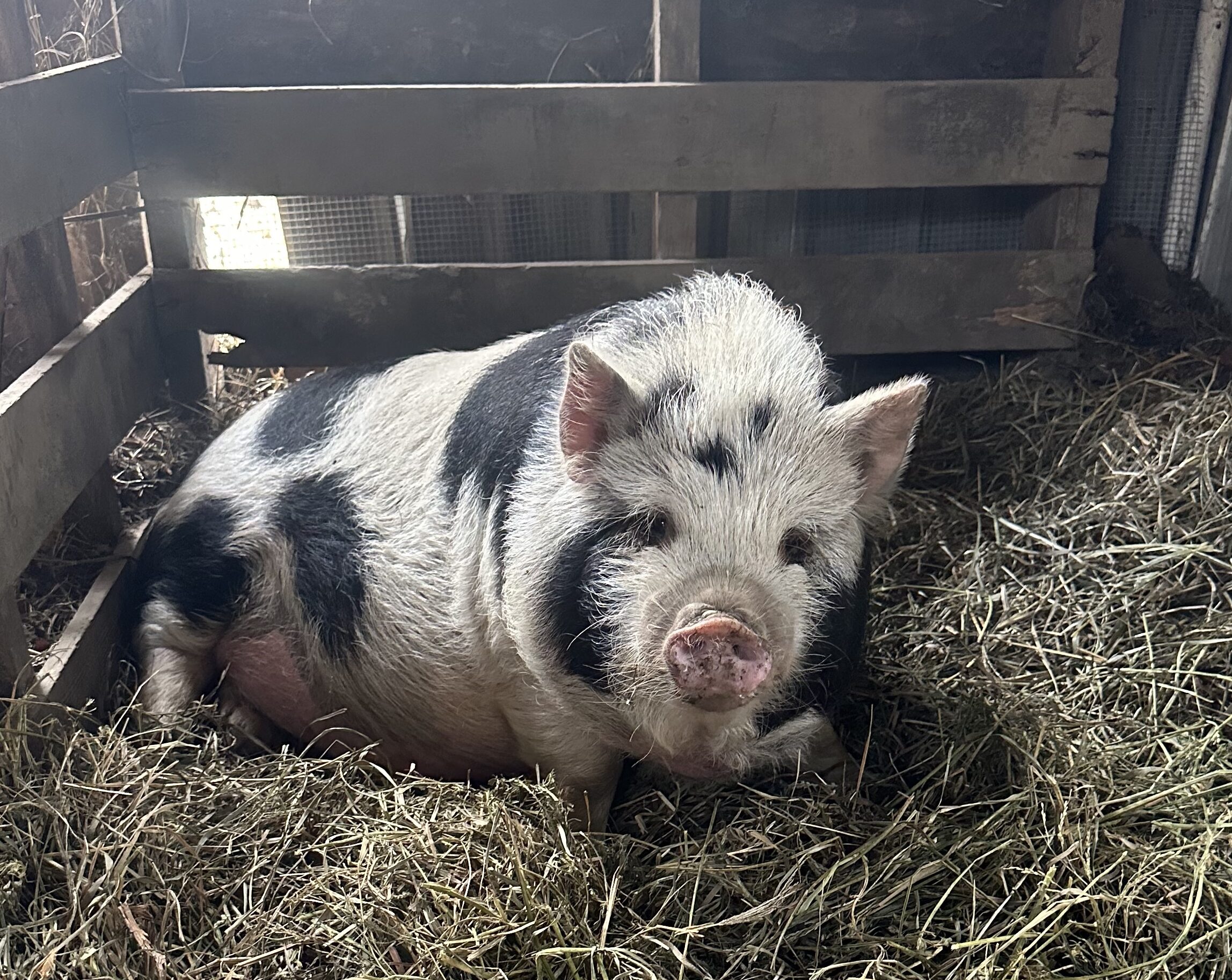
Stinky mud.
My pigs have done exactly what pigs do. They have rooted. And rooted. And rooted some more. What began as vegetated ground now resembles a collection of small archaeological excavations. Eventually I’ll move them and begin regenerating the soil they leave behind.
The frustrating part is that there is plenty of land available. Nearly two acres of my property remain largely untouched. I’d prefer to rotate the pigs through it, allowing them to disturb one area briefly before moving on and giving the soil time to recover.
But moving electric netting is laborious. My water system isn’t particularly mobile. And I need separate enclosures because my boars and sows remain apart until breeding season. Judging by their behavior, they consider this arrangement a serious administrative error.
So I maintain fences.
Standing there sweating, looking through electric netting at unused woodland, I started wondering:
How often do we mistake maintaining constraints for solving problems?
Muddy Ecology
An ecologist wouldn’t look at my muddy pig enclosure and blame the pigs.
After all, rooting is natural pig behavior. Given enough space and appropriate rotation, that disturbance can actually be useful. Pigs expose soil, turn organic matter, consume vegetation, and create opportunities for new plants to emerge.
The problem isn’t necessarily the behavior. It’s the environment in which the behavior occurs.
Concentrate the same animals on the same ground for too long and useful disturbance becomes degradation. That’s an ecological principle.
It’s also a media ecology principle.
Media ecology asks us to look beyond individual messages and consider the environments created by our communication technologies. A technology doesn’t simply give us another tool. It changes the conditions under which human behavior occurs.
Increasingly, our digital environment looks suspiciously like my pig pen.
The Internet offers almost unimaginable intellectual territory. Universities have opened archives. Libraries have digitized collections. Scientists publish research online. Museums make collections available from our couches. Independent writers publish thoughtful essays. We can learn languages, repair tractors, study philosophy, listen to lectures, read newspapers from other countries, and communicate with people we never could have encountered a generation ago.
We have acres of intellectual woodland available to us. And yet we keep rooting the same patch.
Digital Paddocks
Much of our online life now takes place inside a relatively small number of platforms. These environments are useful precisely because they impose boundaries. They organize information, connect us with people we know, recommend things we might enjoy, and give billions of people manageable ways to navigate an impossibly large network.
Electric fences are useful, too. The problem begins when the enclosure becomes the environment.
Our tendencies to gossip, argue, seek approval, tell stories, form tribes, show off, help strangers, and occasionally behave badly didn’t originate with social media. Those are thoroughly human behaviors.
But concentrate them inside environments designed around continual engagement and something changes.
Pigs make craters. Humans make outrage cycles.
The same arguments get rooted up again and again. The same controversies circulate. The same memes appear. The same political opponents become objects of outrage. Yesterday’s scandal disappears just in time for today’s.
Then we build more technologies to manage the consequences: content moderation, spam detection, community standards, fact-checking systems, parental controls, screen-time limits, notification settings, AI-content detectors.
Many serve legitimate purposes. But sometimes I wonder whether we’re doing the digital equivalent of what I was doing this morning: walking around an increasingly complicated enclosure, clipping every weed that touches the fence so the fence can continue functioning.
We become very good at maintaining the constraint. And eventually we stop asking whether the enclosure itself needs redesigning.
From Pigs to Permaculture
Permaculture has gradually taught me to ask a different kind of question.
The obvious question this morning was: How can I clear this fence more efficiently?
The better question was: Why does my system require so much fence clearing?
That shift (from improving a task to reconsidering the system producing the task) is at the heart of good design.
Permaculture doesn’t reject boundaries. A garden needs protection from deer. Chickens need protection from predators. And unless I want an unexpected litter of piglets, some pigs definitely need protection from other pigs. The goal isn’t freedom without limits. It’s designing boundaries that serve the health of the larger system.
That’s what I mean by media permaculture.
Instead of merely asking how to survive our digital environments, we might ask how to cultivate better ones:
- Do we rotate our attention rather than grazing the same feed every day?
- Do we leave some information fields fallow?
- Do we deliberately wander beyond algorithmic recommendations?
- Do we read something longer than a post?
- Do we seek voices outside our ideological paddock?
- Do we create more than we consume?
- Do we build smaller communities where relationships matter more than engagement metrics?
- Do we sometimes simply log off?
These aren’t dramatic acts of technological resistance. They’re design choices.
Permaculture teaches that good systems should become increasingly regenerative rather than requiring ever more energy simply to keep them functioning. A well-designed landscape works with natural patterns instead of constantly fighting them. Don’t our media environments deserve the same scrutiny?
If maintaining a technological system requires increasingly elaborate mechanisms to control problems created by that system, perhaps another moderation tool isn’t always the answer. Perhaps the design itself deserves another look.
Root Access
In computing, having root access means having the authority to change a system at its deepest level. My pigs would undoubtedly interpret the phrase differently. But perhaps both meanings belong here.
There will always be fences on my farm, just as there will always be constraints in technological systems. Boundaries are sometimes necessary and often useful.
But I don’t want to spend all my time maintaining fences while ignoring the abundance beyond them. Sometimes the problem isn’t the weed touching the electric netting. Sometimes the problem isn’t even the fence. Sometimes we need enough root access to ask why we built the system this way in the first place and whether it is still helping us grow.
So, if media permaculture treats human attention as a finite resource, much like soil fertility, what would a genuinely regenerative media environment do to restore attention rather than continually extract it?
Perhaps it would behave more like healthy soil.
Healthy soil isn’t productive because we continually take from it. We return organic matter. We rotate what grows there. We allow periods of rest. We encourage diversity. We disturb thoughtfully rather than constantly. Most importantly, we pay attention to what the system tells us. A regenerative media environment might do the same.
It would give us places where we can actually reach the end rather than scroll forever. It would reward thoughtful contribution over immediate reaction. It would expose us to ideas beyond those an algorithm has learned will keep us clicking. It would encourage making as much as consuming, conversation as much as broadcasting, reflection as much as response.
And sometimes the healthiest thing an information environment could do is let us leave it.
Media permaculture isn’t about rejecting technology any more than regenerative agriculture is about rejecting fences. It’s about design.
We can design technologies that continually harvest our attention until the ground is exhausted. Or we can cultivate media environments that return something to the people who inhabit them: knowledge, curiosity, agency, connection, perspective, and enough quiet to notice the world beyond the screen.
Maybe that’s what regeneration looks like. Not more engagement. Just better soil.
That principle changes what good design looks like:
- A regenerative website helps us find what we came for and eventually lets us leave.
- A regenerative social platform deepens connection without demanding endless attention.
- A regenerative classroom cultivates learners who become increasingly capable of learning without us.
- And a regenerative AI system clarifies, challenges, and assists while ultimately returning agency to the human being.
Different environments. Same design question: What does this system leave behind after we use it?
If the answer is greater knowledge, curiosity, connection, independence, perspective (or simply enough attention left to notice the world beyond the screen) then perhaps we’re beginning to regenerate the soil rather than merely harvest it.
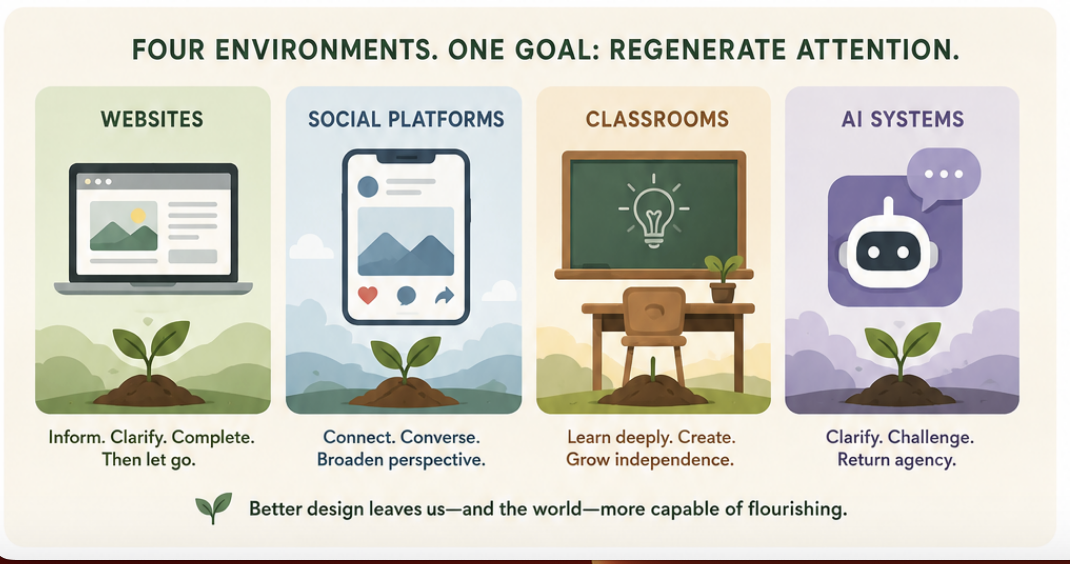
The infographic above is AI-generated. The ideas above are human-generated.