Image above is AI generated. The ideas below are human generated.
Prefer to listen?
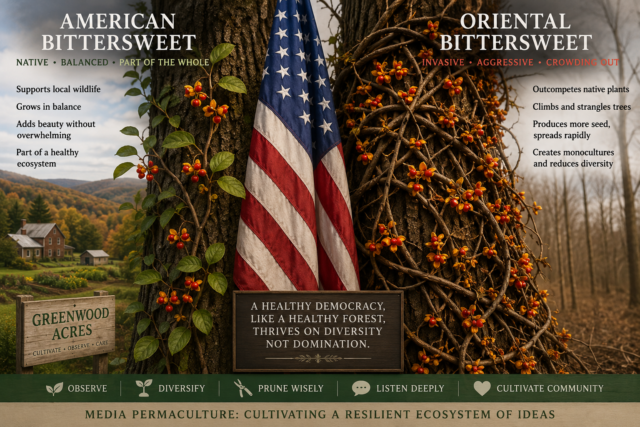
Since regeneratively homesteading in 2022 I have observed that not everything growing is equally good for the land. I have witnessed fifty foot tall black walnut, maple, and ash trees fall to their death due to strangulation. The culprit is bittersweet. Two different kinds of bittersweet, to be exact: American bittersweet and Oriental bittersweet. The vines look remarkably similar. Both climb trees. Both produce colorful berries. Yet over time, their differences become impossible to ignore.
American bittersweet (Celastrus scandens) is native to the United States. It has evolved alongside the forests of eastern North America. It is one member of a much larger ecological community, sharing sunlight, space, and resources with countless other plants and animals. It has natural checks and balances that keep it from overwhelming everything around it.
Oriental bittersweet (Celastrus orbiculatus) is another story. Introduced from Asia (China, Japan, and Korea) it grows faster, climbs higher, produces more seed, and wraps itself so tightly around trees that it will eventually strangle them. Its origin, however, is not what makes it problematic. Ecologists do not judge plants by where they came from, but by how they interact with the ecosystems they inhabit. Some introduced species integrate without disrupting their surroundings. Others become invasive because they grow so aggressively that they overwhelm the diversity that makes an ecosystem resilient. Oriental bittersweet is one of those dangerous species. It spreads rapidly, climbs over trees, blocks sunlight, and can eventually dominate an entire woodland. The danger is not simply that Oriental bittersweet exists, but that it crowds out everything else. Before long, a healthy woodland becomes a bittersweet monoculture.
As I (and my hungry goats) worked among these two competing vines I thought about today’s information environment, particularly as it relates to national politics.
Healthy democracies (like healthy forests) depend on diversity rather than domination. A resilient society does not require everyone to think alike, but it does require room for many voices, careful observation, and thoughtful disagreement. Problems arise when any single source of influence (political, commercial, technological, or ideological) grows so dominant that it crowds out meaningful engagement with other perspectives. When one ideology becomes so aggressive that it wraps itself around every conversation, every relationship, and every source of information, it begins to resemble bittersweet strangulation more than a thriving ecosystem.
The problem is not disagreement, however. The problem is one perspective growing so aggressively that little else can survive beside it.
This is where media permaculture offers a useful framework.
Permaculture teaches us to observe before acting, value diversity, build resilient systems, and intervene thoughtfully rather than reacting impulsively. Those same principles can guide how we cultivate our media landscape. Instead of allowing one news source, one social media algorithm, or one political tribe to monopolize our attention, we can intentionally plant a richer media ecosystem. Read across viewpoints. Slow down before sharing. Prune misinformation wherever it appears, including when it confirms our own biases. Leave room for complexity.
On my homestead, I don’t eradicate every vine simply because it’s a vine. I learn what it is, observe how it behaves, and decide whether it contributes to the health of the larger ecosystem. Perhaps our conversations deserve the same care.
Healthy forests are not defined by uniformity. They are defined by resilience, diversity, and interdependence. The same is true of healthy democracies. And of the media ecosystems we cultivate every day.